Drone jammers and counter-UAS systems handheld, man-portable and vehicle systems: detect, jam, divert
Three tiers of drone defence: what the operator holds in their hands, what they carry on their back, and what sits on a vehicle. The equipment runs on its own — no external services, no subscription, and no third-party server in the control chain.
From what you hold to what rides on a vehicle
The tiers differ by task, not by "power": hold a point, cover a sector, or watch the far approaches. Below are figures you can verify at acceptance rather than advertising copy.
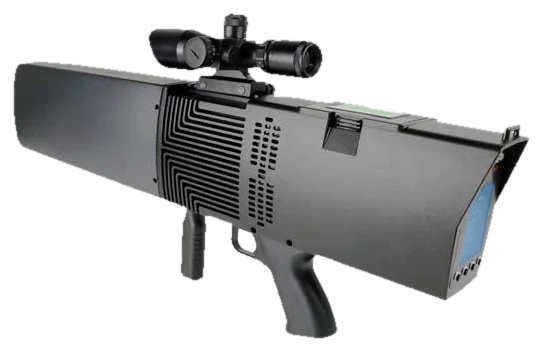
Handheld counter-UAS jammer AK-H8
A handheld jammer built for first response. Eight bands cover control, telemetry and video links, including FPV and frequency-hopping airframes. One person brings it to readiness; it opens like a weapon — a trigger instead of a menu.
| Jamming bands | 400 / 900 МГц · 1,2 / 1,4 / 1,5 / 2,4 / 5,2 / 5,8 ГГц |
|---|---|
| Jamming range | 1–2 кмline of sight |
| Effect on target | увод · посадка · зависание · подавление видеоканалаrepel · land · hover · video link denial |
| Antenna | встроенная направленная, высокий коэффициент усиленияintegrated high-gain directional |
| Response time | ≤ 3 с |
| Deploy and stow | ≤ 15 с |
| Power | сменный аккумулятор, 28 Вswappable battery, 28 V; 60 min typical |
| Controls | один оператор; независимые выключатели диапазонов; пуск с куркаsingle operator; independent band switches; trigger fire |
| Body | алюминий 7075, интеллектуальное терморегулирование7075 aluminium, active thermal control |
| Operating temperature | −40…+60 °C |
| Dimensions | 480 × 250 × 86 ммincluding integrated directional antenna |
| Weight | 3,5 кг |
| In the case | зарядное устройство · защитный кейс · аккумулятор · прицелcharger · hard case · battery · sight |
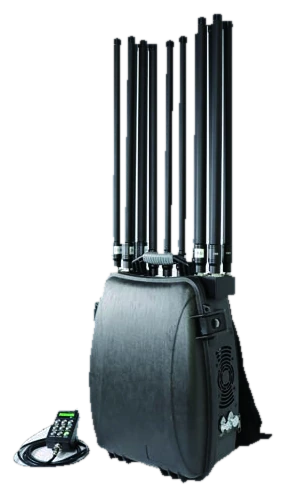
Rucksack AK-R3: detect, jam, spoof
A complete man-portable suite in one pack: it finds the airframe by spectrum and RID, shows the operator the model, altitude and launch point, jams the control link and draws the aircraft away by spoofing navigation. One person covers ground a vehicle cannot reach.
| Detection range | 20 МГц – 6 ГГцcontinuous panorama, FPV video included |
|---|---|
| Detection distance | 1–3 км |
| Detection sector | 360° по горизонталиhorizontal 360° |
| Positioning accuracy | ≤ 10 мfrom RID and spectrum data |
| Jamming bands | 900 МГц · 1,5 / 2,4 / 5,2 / 5,8 ГГц |
| Jamming sector | 360° по горизонтали / 90° по вертикали360° horizontal / 90° vertical |
| Jamming distance | 1–3 км |
| Navigation spoofing | G1 / B1 / L1 / E1repel · no-fly enforcement |
| Spoofing distance | 1–3 км |
| Power output | регулируемаяadjustable |
| Emission level | ≤ 12 В/м |
| Console | сенсорный экран 10″; разбор SN-кода: модель, высота, координаты оператора10-inch touchscreen; SN parsing: model, altitude, pilot position |
| Power | сеть 220 В или аккумулятор 28 Вmains 220 V or 28 V battery |
| Operating temperature | −30…+55 °C |
| Ingress protection | IP66 |
| Weight | 13 кгfully equipped |
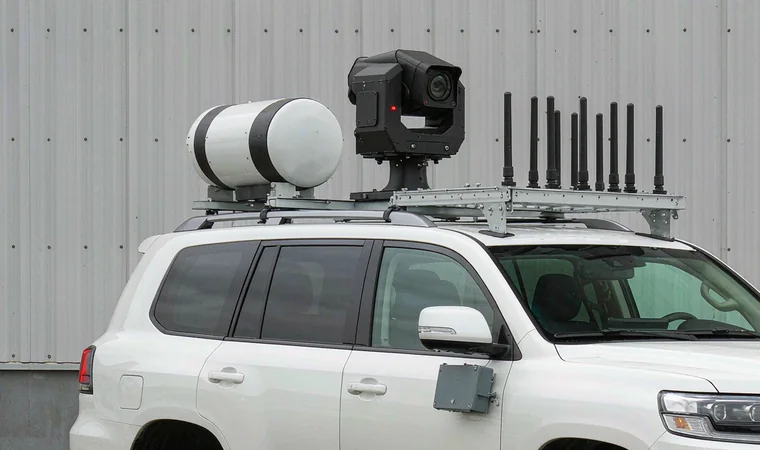
Mobile counter-UAS suite AK-M5
A suite for vehicle or fixed installation: radar picks the aircraft up on approach, optics identify it, a servo mount points jamming and spoofing at it. It runs unattended around the clock — the operator is there to make the call, not to aim.
| Detection | радар + оптика (видимый и ИК) + спектральный модульradar + visible/IR optics + spectrum module |
|---|---|
| Detection frequency | 70 МГц – 6 ГГц |
| Detection distance | 1–5 кмradar; optics for identification |
| Jamming bands | 5 диапазонов по заказу + цифровой широкополосный модуль5 configurable bands plus a digital wideband module |
| Jamming distance | 1–3 км |
| Navigation spoofing | G1 / B1 / L1 / E1 |
| Spoofing distance | 1–3 км |
| Pointing | поворотная платформа с сервоприводомservo-driven mount |
| Duty cycle | круглосуточно, без оператора24/7, unattended |
| Power | сеть 220 В; от бортовой сети через инверторmains 220 V; vehicle supply via inverter |
| Operating temperature | −40…+60 °C |
| Ingress protection | IP65 |
| Deployment | автомобиль или стационарная мачтаvehicle or fixed mast |
What happens at each step
The difference between systems is not their weight but where automation ends and the operator's decision begins.
Which band covers which link
Eight bands is not "more is better" — it is coverage of specific links. The table shows which channel sits on which frequency, and why the band list is matched to the site rather than bought at maximum.
| 2.4 GHz | control and telemetry on most consumer airframesthe primary target against quadcopters |
|---|---|
| 5.2 / 5.8 GHz | video link; on FPV drones also the control linkdenying video costs the pilot the picture |
| 1.2 / 1.4 GHz | video and control on long-range builds and analogue FPVthe bands most often left uncovered |
| 900 MHz | long-range control, some industrial and custom airframes |
| 1.5 GHz | satellite navigation reception (GPS L1 / GLONASS G1)here the effect is spoofing, not jamming: the aircraft is diverted, not dropped |
| 400 MHz | service and custom channels, some analogue transmitters |
Typical sites
The list covers the places where a drone causes measurable damage: a stopped production line, a data leak, a cancelled event.
When jamming will not work
Below are the cases where the complex delivers no result, and what works instead.
The aircraft is controlled over fibre
The control link is a physical wire. Radio jamming does not affect it at all: there is nothing to jam because nothing is radiated.
It flies on optics alone, with no radio and no GNSS
A fully autonomous flight along a preloaded map or by visual reference: no control, no telemetry, no navigation reception to take hold of.
The target is outside the sector or behind terrain
Directional jamming works inside a cone. If the aircraft approaches from another side, from behind a quarry wall or behind a building, it sits outside the pattern — while the equipment is formally working.
If someone promises you jamming of any drone in any conditions, ask them how. The answer tells you more about the supplier than any catalogue.
Why expectations diverge from results
These are working conditions. We fix them before the contract: at acceptance they turn into a dispute if they were never agreed.
Conditions without which the equipment is not commissioned
Radiating equipment is a regulated category almost everywhere. Below is what gets checked before delivery rather than after.
- Supply to organisations only. Equipment is transferred to a legal entity or a registered business for site protection. We do not sell to private individuals.
- The regulator of the country of operation sets the procedure. Permits, approvals and the switching-on procedure are the operator's responsibility. We supply the technical data that this document set requires.
- Jamming must not affect civilian networks. The band list is fixed against the site environment: unused frequencies are disabled in hardware, not "by eye" through a menu.
- Breaching radio-frequency rules is a separate offence. For the operating organisation it falls under art. 13.4 of the Russian Code of Administrative Offences: a corporate fine and, as a measure, seizure of the equipment. Clearance is a condition of operation, not paperwork.
What arrives with the equipment
Warranty terms and response times depend on the configuration and scope of supply, so we do not print them on the site: they go into the quotation and are fixed in the contract before signing.
Technical specification — sent by email on request
The full document covers all three systems: figures for every band, the placement drawing, delivery scope and acceptance terms. We do not publish it openly: it contains configuration specific values, and part of the data relates to customer sites.
- Site — what you are protecting: plant, perimeter, warehouse, event
- Scale — area or perimeter length, buildings and terrain
- What you see — drone types, altitude and approach distance
- Scope — detection only or detection with jamming; quantity and date
We reply within one business day. If the task is outside our scope we say so straight away instead of stretching a quote to fit.
- PDF specification: figures, bands, dimensions, power
- Placement drawing for your site: sectors, mounting height, blind zones
- Document set: unit passport, operating manual, factory test record
- Draft quotation: delivery date, commissioning, operator training, spares
- Site acceptance test (SAT) terms
What buyers ask before ordering
Is the quoted range a guarantee?
No, and no supplier can guarantee it. Range depends on line of sight, terrain, buildings, humidity and the airframe itself: the same unit gives a difference of several times over between open ground and dense urban fabric.
That is why we quote an operating band (1–3 km) and record in the test report the conditions under which it was measured. If the figure is lower at your site, that is a configuration question rather than a false claim, and it is solved with antennas and mounting positions.
What happens to the drone once jamming starts?
It depends which link is denied. With control and telemetry denied, the airframe usually enters return-to-home or lands in place. With the video link denied, the pilot loses the picture but keeps control.
Spoofing works differently: the aircraft is not brought down, it is drawn in a given direction or blocked from entering a zone. For sites where a falling drone is dangerous in itself — over people, over a process unit — that difference is the whole point.
Can the system be added to a site that already has security?
Yes, and that is the normal case. The system needs no rebuild of what you have: it either works standalone or feeds your control room. During assessment we look at camera positions and the perimeter route so the antenna does not end up in a dead zone.
How do I choose between handheld, backpack and vehicle?
By task, not by budget. Handheld — response to a signal and work on a specific target. Backpack — covering a sector where you need both detection and effect, and where a vehicle cannot go. Vehicle — continuous watch of the far approaches with no operator at a console.
The right answer is often a combination: a fixed or vehicle loop on the perimeter plus a handheld in the response team.
Will the system interfere with communications on site?
Jamming is directional and switched on band by band, not all at once: the operator or the automation works on the frequencies the target uses. That is exactly why the band list is fixed against the site environment.
Radiating equipment still needs clearance from your radio authority — we neither skip that step nor advise skipping it.
Is a permit required to use it?
In most jurisdictions yes, and the procedure differs: in some places it is frequency clearance, in others a permit for countermeasure use. We do not act as a regulator and do not promise to "clear everything".
What we do: supply technical characteristics to the extent your document package needs, and state in the contract that the operator determines the procedure of use.
What about maintenance and spares?
Batteries, antennas and mounts are consumables; the set is agreed at order. The maintenance schedule ships with the operating manual: it describes what is checked before every switch-on and what is checked quarterly.
Why do different suppliers quote the same numbers with different results on site?
Because a figure without measurement conditions means nothing. "Up to 3 km" can be obtained over open ground with one antenna and one airframe, or under the real conditions of your site.
Our test is simple: ask the supplier for a test report stating the conditions — terrain, mounting height, airframe type, what was used to measure. No report means no measurement, and the figure came from a catalogue. That applies to us too: we hand over a report for your configuration.
Do you guarantee that no drone gets through?
No, and nobody can. The system lowers the probability and buys reaction time; it is not a dome that seals a site.
The contract fixes measurable values: detection and jamming range under stated conditions, deployment time, operator procedure. Those we stand behind. "Absolute protection" is not something any supplier in the world can stand behind.
Is equipment in stock?
It depends on configuration: a standard band set builds faster, a non-standard one has to be manufactured. Lead time is fixed in the contract after the specification is agreed — we do not quote it before that, so the date does not move afterwards.
Describe the site — we propose a configuration
What you protect, the area and terrain, which security systems are already in place and which airframes are causing trouble. You get a layout drawing and a configuration quotation.
batony@agent.qq.com